

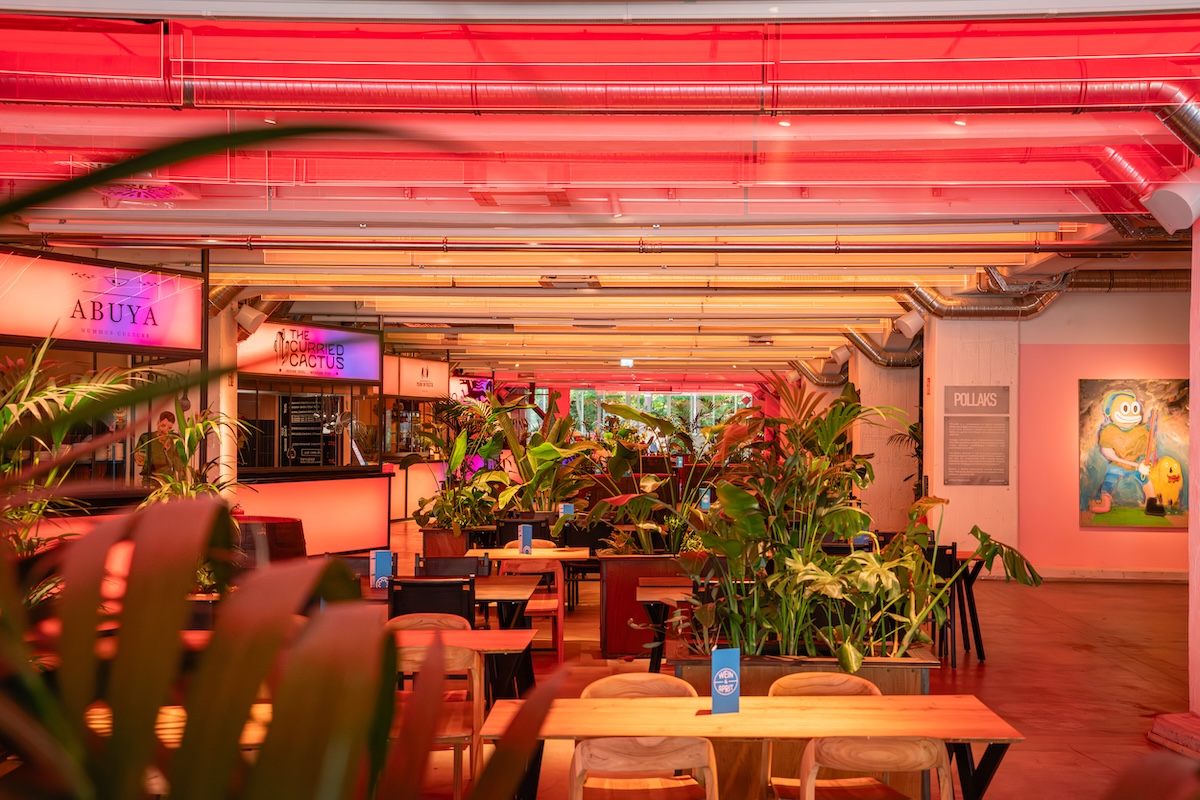
There are few places in Berlin where the past and the present seem to occupy the same breath. At the Kant-Garagenpalast, the city’s modernist ambition is still written into the architecture: concrete, curves and the extraordinary sweep of its double helix, built in the late 1920s for an age that believed the automobile was the future. Now, almost a century later, the building has been given a new reason to gather people. Dufte is not a restaurant, a bar or a food hall. It is something looser—and, in many ways, more Berlin: a culinary cultural house designed to keep people around.
Created by the experience design studio FictionFactory, Dufte takes its cues from the building rather than attempting to overpower it. The Kant-Garagenpalast is a piece of Berlin architectural history, one of Europe’s oldest surviving multistory parking garages, and its inherent roughness provides the setting for a contemporary social space. Here, the architecture is not merely a backdrop to food and drink. It is part of the experience, giving the project a sense of permanence even as everything inside remains deliberately open to change.

The concept unfolds across multiple culinary and social worlds: four kitchens, two bars, a café, a bakery and a beer garden, alongside music, live performances and a cultural program. Rather than dividing these experiences into hermetic concepts, Dufte allows them to coexist. A guest might arrive for fresh pasta at Mani in Pasta, move on to hummus from Abuya, encounter the Mumbai-meets-Mexico cooking of The Curried Cactus, and finish with Tacho’s contemporary take on German food. The spaces are connected by the simple idea that good hospitality should encourage lingering.
That sense of informality is crucial. Dufte draws on the Berlin tradition of spaces that refuse to behave too perfectly: the improvised alongside the precise, the polished beside the rough, the old beside the new. The result is less about creating a particular aesthetic than about creating an atmosphere in which different people, tastes and conversations can overlap.
Light plays an important role in bringing the historic structure into the present. The concrete architecture of the garage, once associated with movement and machinery, becomes a framework for a warmer, more human kind of circulation. Tables, counters, bars and communal areas turn the building into a sequence of encounters rather than a conventional hospitality interior. There is no single room in which the experience is supposed to happen. Dufte is designed as a landscape of possibilities.

Its cultural ambitions reinforce that openness. Art, music and live performance are treated as intrinsic rather than decorative, allowing the building to function as a meeting point from morning until late at night. The architecture’s original purpose was to accommodate a new urban lifestyle; Dufte, in its own way, does something similar for contemporary Berlin.
Food pairing at Wein & Sprit bar: Whether it’s a Sumac Spritz, Tamarind Paloma, or Tomato Martini, every drink here is designed to complement the four kitchens.
Interior
FictionFactory
Design
custom made, design by FictionFactory


